Spring Rite
The Rite of Spring (Igor Stravinsky)
Few works have left such a lasting mark on the history of music as The Rite of Spring. Premiered in 1913 by Diaghilev’s Ballets Russes, its brutal originality caused an unprecedented scandal among the audience. Stravinsky depicts a pagan ritual in which a young girl is sacrificed to the gods to welcome the spring. To do this, he abandons the idea of “beauty” in favor of the “musical object”. Through archaic melodies, dissonant harmonies, layered textures, and tribal rhythms, the composer transports us to a primitive world and connects us with that ancestral instinct that still resides within us.
The ballet is divided into two parts, presenting different soundscapes. The Adoration of the Earth draws us into the daily life of a prehistoric tribe. We hear dances, games, tribal conflicts, and moments of worship and ecstasy. The second part, The Sacrifice, begins mysteriously, with mystical chants and long processions that induce a trance-like state. When the elders identify “the chosen one” the procession stops abruptly. In the “sacrificial dance” she must dance to the point of exhaustion and death. The rhythm becomes urgent, and a brutal ostinato drives us to the inevitable conclusion. The final chord is built from the notes D–E–A–D.
The current four-hand piano transcription, written by Stravinsky in parallel to the symphonic version, was premiered by the composer himself and Debussy. Although the orchestral version is the most widely known, this version loses none of its primal force; the pianistic texture reveals the sonic architecture of the work with clarity, showcasing Stravinsky’s supernatural command of rhythm, his precise use of motivic repetition and layering, and dazzling thematic originality.
Anton & Maite
Maite León and Antón Dolgov met in 2011 in Madrid, immediately feeling a strong musical and personal connection. Since then, the duo has performed over 100 concerts across four continents. In recent years, they have played in renowned stages such as the Palau de la Música Catalana, Teatro de la Maestranza, Auditorio Manuel de Falla, Auditorio de Zaragoza, Krakow Philharmonic, Lima Philharmonic Society, Musikverein in Graz, and the Grand Theatre of Harbin in China.
They have collaborated with the Krakow Philharmonic Orchestra, Cusco Symphony Orchestra, Zaragoza Symphony Orchestra, KUG Symphony Orchestra, and the Orchestra of the Aragón Conservatory of Music, under the baton of conductors such as Ralf Weikert, Theo Tupayachi, Lucasz Borowicz, and Miquel Rodrigo.
They have appeared at prestigious festivals including the Schubertíada de Vilabertrán, Granada Festival, Rafael Orozco Piano Festival in Córdoba, and the Berlin Piano Duo Festival, among others. The high level of their performances, combined with their on-stage personality, has earned them over ten international awards, including First Prize at the Mirabent i Magrans International Competition, First Prize at the Luigi Zanuccoli International Competition, First Prize at the Antón García Abril International Competition, and the Special Award for Best Performance of a García Abril Work. They have also received the Extraordinary Prize El Primer Palau and Second Prize at Jeunesses Musicales of Spain, among others.
Critics have described their performances as “a true spectacle”, “pure seduction” (Catalunya Radio), and “truly overwhelming” (Diario de Sevilla). Ritmo magazine praises their “admirable technical perfection, musicality, and strength,” while Heraldo de Aragón highlights their “perfect synchronization between both pianists.”
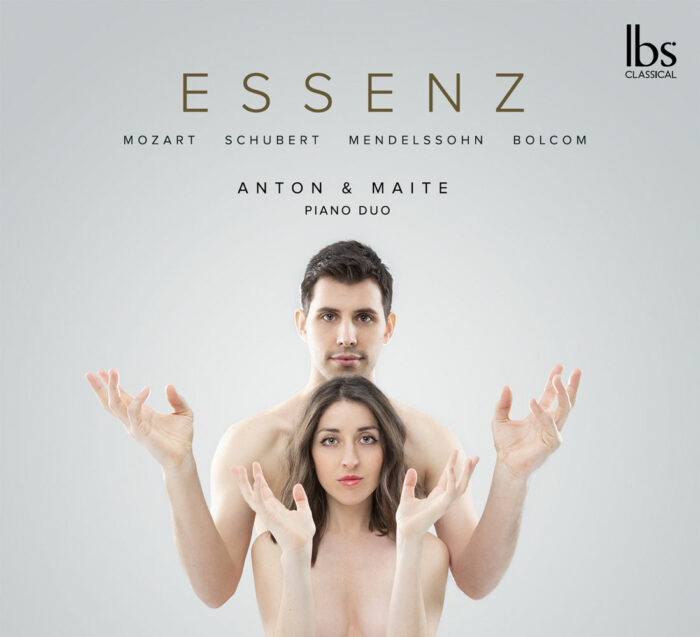
Their debut album, ESSENZ, produced by IBS Classical, received the Melómano de Oro and five stars from Ritmo magazine, and highlighted by Pulitzer Prize-winning composer William Bolcom. Antón and Maite are also passionate piano teachers, communicators, and editors. They have made arrangements and critical editions of works by Fernando Remacha, José Bottiroli, and William Bolcom, among others. As active artists on social media, they advocate for the art of piano duo and strive to bring classical music closer to new audiences, with over 80,000 followers on their Instagram and TikTok accounts.