

ÆTERNUM: Tempus Trio
Albert Guinovart: Trio Celebreation - II. Presto
14,95€
With Æternum, the Tempus Trio presents a debut recording that firmly positions the ensemble within the most compelling landscape of contemporary chamber music in Spain. The album brings together four works written expressly for the trio by Helena Cánovas, Marc Migó, Miquel Oliu, and Albert Guinovart—composers whose contrasting aesthetic languages form a representative panorama of current creation. The conceptual backbone of the project—music’s relationship with time—is not treated as a mere unifying idea, but as a structural and poetic principle that permeates the entire album. The notion of an “eternal” moment arising from the ephemeral act of performance, suggested in the title Æternum, becomes a multidimensional exploration: fragmented time, expanded time, suspended time. The programme thus forms a dialogue between introspection, symbolism, and post-romantic narrative.
BOOKLET
14,95€
Æternum
Æternum is a gesture towards time; this name, which means “eternal” in Latin, reflects the essence of our project: the idea that music, although ephemeral at the moment of its creation, can continue to resonate far beyond its present.
Our debut recording brings together works by Helena Cánovas, Marc Migó, Miquel Oliu and Albert Guinovart, all composed and dedicated to the Tempus Trio. The diversity of their perspectives creates a vivid portrait of our contemporaneity.
With Æternum, we highlight the strength and relevance of today’s music and express our conviction that contemporary creation can meaningfully dialogue with tradition, weaving a sonic thread that preserves its intensity and sensitivity. This project is also a gesture of gratitude to all who have trusted us and made these works come to life.
Tempus Trio
About Pieces
tanta llunyania no ha estat un error
November, night
(…)
Tonight, it is a night of rain.
We can cross it in two different brightnesses without light,
say, by touching the icy edge of a glass,
that so much distance has not been a mistake
if, secretly, it has tightened and unleashed
every unreal desire.
Nights of Western Peace, Antonella Anedda, Translated to Catalan by Nora Albert. XVIII Jordi Domènech Prize for Poetry Translation, Ed. Jardins de Samarcanda #108. English translation by Tempus Trio from the Catalan version.
To look for the ray of light that emerges from among the clouds, to catch in flight the leaf that falls from the tree, to observe the movement of a pendulum, to sink one’s foot into the sand and watch how the waves blur the footprint, to try to find a cricket that sings alone amid the bush. All these states are states of waiting, where ‘doing nothing’ plays a very important role, but also become states of exploring, where expectation or dreaming play a very important part.
Taking its title from a verse of November, night by Antonella Anedda in Nora Albert’s translation, the work tanta llunyania no ha estat un error describes different situations in which the three performers look, wait, search for one another, touch, but perhaps never meet. The piece does not follow a single or clear narrative: it explores different moments focused on how the three performers interact with each other.
It is written in a single movement, though it works with formal fragmentation: throughout the piece we discover sounds and moments that, almost always, appear without repetition, as if they were unique states. These sometimes appear by surprise, sometimes as the result of a longer process, sometimes as the response to a previous event.
The work is surrounded by nostalgic, distant sonorities and harmonies that create atmospheres and states of rest or waiting. Often, the harmonic treatment tends toward reduction: intervals are repeated, chords return—though always from a different place or with a new articulation. These winter-like, introspective colours transform without warning into bright textures, with livelier hues. This waiting may lead to results we could not always foresee.
In this work I have sought that state or sensation that we all know in life: the feeling of watching something from afar, yearning for it to arrive, instead of rushing to seek it out. It invites us to let ourselves be carried along by an unknown journey and to enjoy the spaces through which it leads us.
Helena Cánovas
Commissioned by Tempus Trio in 2024.
World premiere at Auditorio “El Círculo” in Burgos in October 2026.
Gem(s)tone
When the Tempus Trio commissioned me to write a new work, I immediately felt it was an exceptional opportunity to pay homage to my mother’s deep interest in gemstones. A gemmologist by profession, she has passed on to me a lifelong fascination with gems; although I am familiar with that world, I have no formal theoretical or scientific training. Therefore, my approach has been entirely intuitive, guided by my musical perceptions and by the symbolic and esoteric connotations that these stones evoke.
In GEM(S)TONE, the musical narrative is structured around three very different gemstones, exploring not their physical properties, but their symbolic and emotional essence. They appear in this order: Ònix, a dark and mystical protector; Rubí, a symbol of nobility and romantic passion; and Diamant, a blazing light radiating intensity and brilliance. The movements flow without pause, building a journey that moves from the low register to the hyper-high; from lack of contour to sharp definition; from meditative stillness to explosions of sonic fireworks. This progression reveals the exquisite musicality and flawless technique of Tempus Trio.
With this work, I wished to capture not only the character of each gem but also the way in which these essences can be transformed into sonic landscapes, weaving a musically unified journey within their diversity—like an imaginary necklace where an onyx, a ruby, and a diamond relate to each other and dialogue through time and sound.
Marc Migó
Commissioned by Tempus Trio in 2022.
World premiere at the Fundación Juan March Auditorium in Madrid on 5 March, 2023.
Un simple aleteig…
The figure of the butterfly —with its lightness, its agile and vivid fluttering, its variety of colours— has been the source of inspiration for this trio for violin, cello, and piano. The abundance of natural harmonics on the strings and a movement of oscillation between two notes in the form of tremolo or trill permeate the entire piece, evoking that weightless flutter and seeking a clearer, more transparent sonic texture, where timbral work prevails.
The well-known Eastern proverb ‘the simple flutter of a butterfly’s wings can be felt on the other side of the world as a hurricane’ was the starting point for this trio, which unfolds in three relatively brief movements. The first, Un simple aleteig…, corresponds to the presentation of the proverb; more descriptive in character, it seeks to reflect that innocent beginning of the butterfly’s flutter which, little by little, is being transformed until reaching its climax in the representation of the circular force and energy of a small hurricane. This movement serves as a gateway into the two following ‘resonances’.
The first, Ressonància I, corresponds to a feeling of serene sadness, of apology, for the pain that each of us —and the world— may cause, unintentionally and unconsciously. With a melodic treatment of oscillation between two notes and a sense of descending chromaticism, it aims to be the most expressive and reflective movement.
The second, Ressonància II, corresponds to the idea that everything is connected, to a certain awareness of ‘the whole that connects all things’, which makes possible a way of acting more harmoniously with all that surrounds us, and an identification with the butterfly from essence to essence. It seeks to be a less discursive, more contemplative, serene movement, in search of greater simplicity. It is built upon a small rhythmic element, in the form of an internal heartbeat, latent throughout the movement, where the three instruments unite in the oscillating motif, which here takes on a character of innocent simplicity.
In preparing the materials for this composition, I drew upon ‘findings’ from various composers, with special attention to the work of Kaija Saariaho. The coincidence of this work with her passing, and my admiration for her Sept papillons, inspired me to write this trio in her memory, as a humble tribute.
Un simple aleteig… is dedicated to Tempus Trio, with gratitude for their interest, meticulous work, enthusiasm, and shared moments.
Miquel Oliu
Dedicated to Tempus Trio in 2023.
World premiere at the Sant Josep Auditorium in Moià on 23 November, 2024.
Trio Celebration
The composition of this trio was a commission from Tempus Trio to celebrate their fifth anniversary as a chamber ensemble. The fact that the request came from the very musicians who were to premiere it was, of course, a source of great emotion and gratitude for me; moreover, it was my first attempt at writing a chamber work for piano, violin, and cello. Having performed on several occasions with the members of the group and holding great admiration for their artistry, the composition was entirely tailor-made to highlight their expressiveness and virtuosity.
The trio consists of four movements, in the image of Romantic trios, with considerable scope. As a pianist myself, I have performed the most emblematic trios in the repertoire (Mozart, Beethoven, and especially the two by Schubert, as well as Mendelssohn, Tchaikovsky, etc.), and it is from this musical period that I have drawn inspiration.
The first movement is a variant of the sonata form. It bears the subtitle Nits a Moià, a Catalan town with a strong musical tradition to which we have a special connection. Despite its musical structure, I have tried to capture a nocturnal atmosphere, although there are also more romantic episodes, and others that are livelier and more rhythmic.
The second movement could be defined as a Scherzo, with a main rhythmic section, lively and full of meter changes, containing two very different episodes: a nostalgic waltz and another moment, which is more mysterious and contemplative.
The third movement is a fairly extended Adagio, where I combine different themes with a twelve-tone cell that begins in the piano and recurs throughout. In one of the melodic themes, I adopt an accompaniment pattern from the slow movement of Schubert’s second trio, as a homage. The developments of the various themes lead to a mysterious conclusion.
The fourth and final movement is titled A Tribute to Purcell because, starting from the music of his well-known The Cold Song (from his opera King Arthur), I present the theme harmonically on the piano and build free variations around it. A waltz and a final gallop allow these extraordinary musicians to display their great virtuosity, having commissioned and performed the work.
Albert Guinovart
Commissioned by Tempus Trio in 2025.
World premiere at the Terrassa Auditorium on 9 March, 2025.
Tempus Trio
El Tempus Trio fue fundado con el deseo de explorar el gran repertorio para trío de piano y, al mismo tiempo, buscar un diálogo contemporáneo para seguir desarrollando la literatura musical del ensemble. Los críticos los han descrito como uno de los más prometedores de su generación, logrando importantes éxitos en varios concursos internacionales; han sido galardonados con el primer premio del Concurso Internacional de Música ‘Gran Premio Virtuoso’ en Bruselas, la Medalla de Platino (Primer Premio) del ‘Concurso Internacional de Música de Singapur WPTA’, la Medalla de Plata del ‘2º Concurso Internacional de Viena’, el premio especial del ‘Concurso de Música de Cámara BBVA’, el tercer premio del ‘Concurso Internacional de Estrellas Emergentes de Berlín’, el primer premio ex aequo en el concurso internacional «Città di Padova» y el primer premio en el «Concurso Internacional Petrichor 2023» en Nueva York, EE. UU. En la temporada pasada, debutaron en el Carnegie Hall (Nova York) como ganadores del primer premio del concurso “Golden Classic Music Awards 2024”.
El conjunto es el primer trío con piano en haber completado una Máster en la prestigiosa Universidad Mozarteum de Salzburgo bajo la guía del Profesor Cibrán Sierra Vázquez, violinista del Cuarteto Quiroga. Son regularmente invitados por la «European Chamber Music Academy» (ECMA, Viena) y han sido seleccionados para unirse a la red artística «Le Dimore del Quartetto» (Milán).
Su trayectoria profesional abarca una mirada polifacética que se materializa en importantes masterclasses y festivales de todo el mundo, como el Festival Musical Chairs de Canadá (McGill University) o el Chamber Music Festival de Múnich, donde fueron grabados por la Bayerischer Rundfunk (Radio Nacional de Baviera).
Han tenido el privilegio de ser artistas residentes de Joventuts Musicals de Moià durante tres años (2022-2024) y actualmente son profesores de instrumento individual y de música de cámara en el Campus Musical del Moianès, que se celebra cada verano.
También te recomendamos…
-
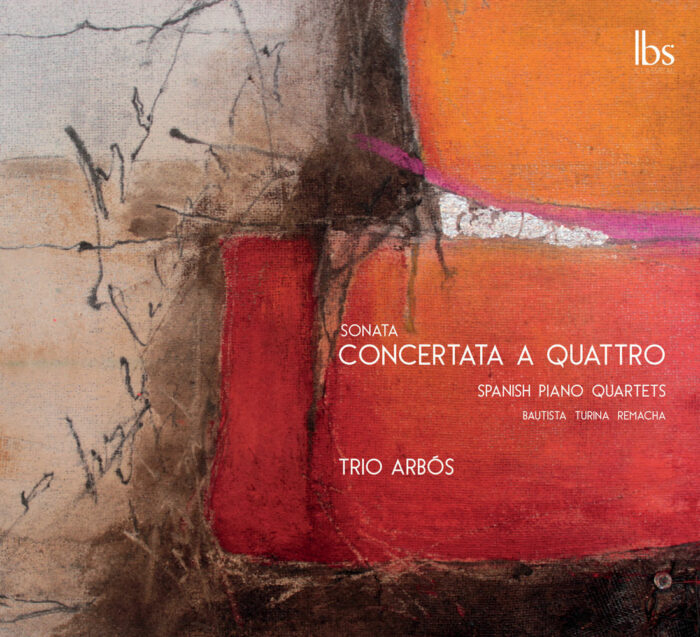 Sonata Concertata 13,95€
 -
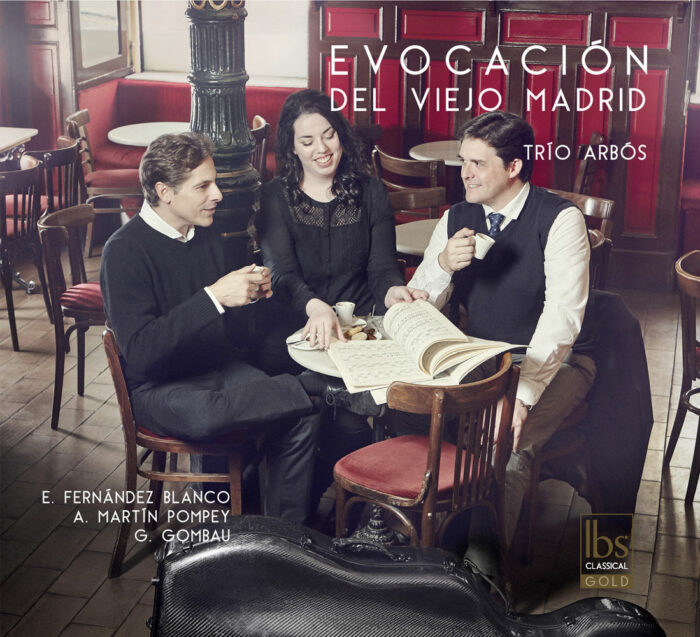 Evocación 13,95€
 -
 Turina Piano Trios 14,95€
 -
 Spanish Trios 14,95€
 -
 Trios Hispanos 14,95€
 -
 Mozart Piano Trios 17,95€
Productos relacionados
-
 Breton Songs & Piano Trios 18,95€
 -
 Philip Cashian 14,95€
 -
 Kammersymphonie 14,95€
 -
 Sorozábal Choral Works 14,95€
 -
 Membra Jesu Nostri 14,95€
 -
 Chanzonetas 14,95€